![]() |
||
|
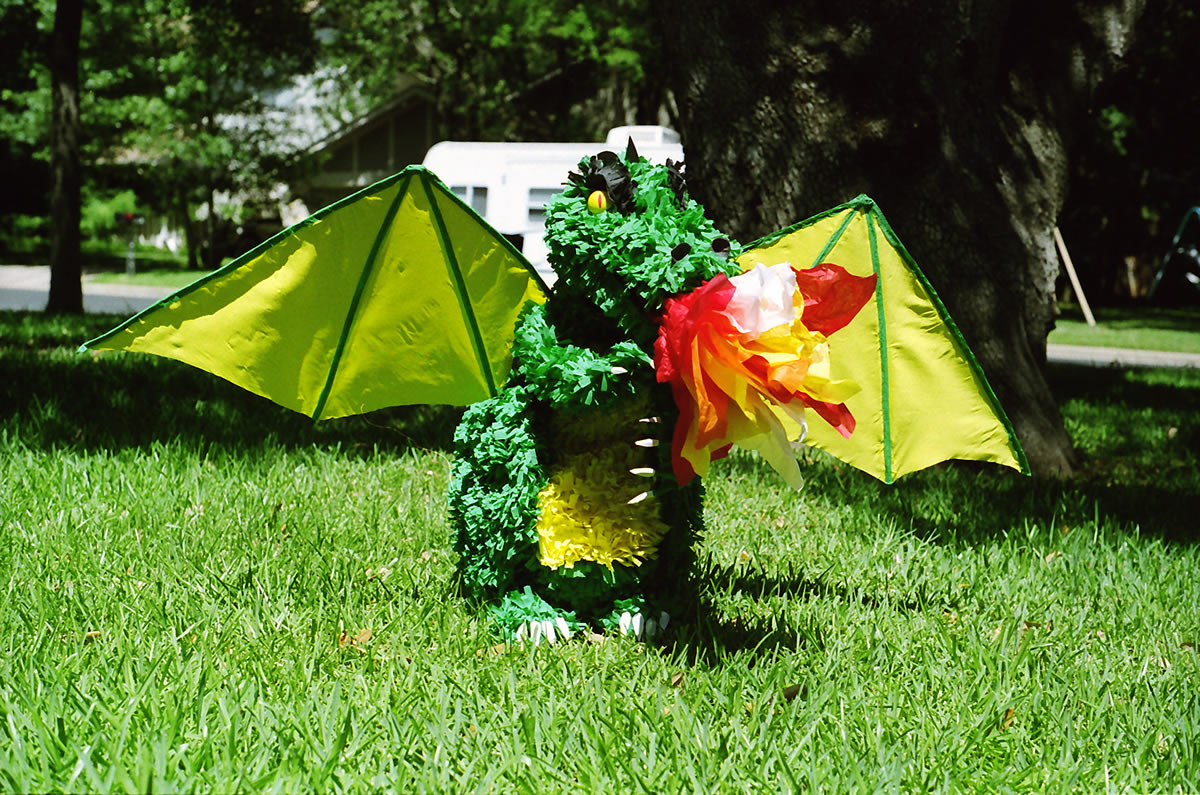
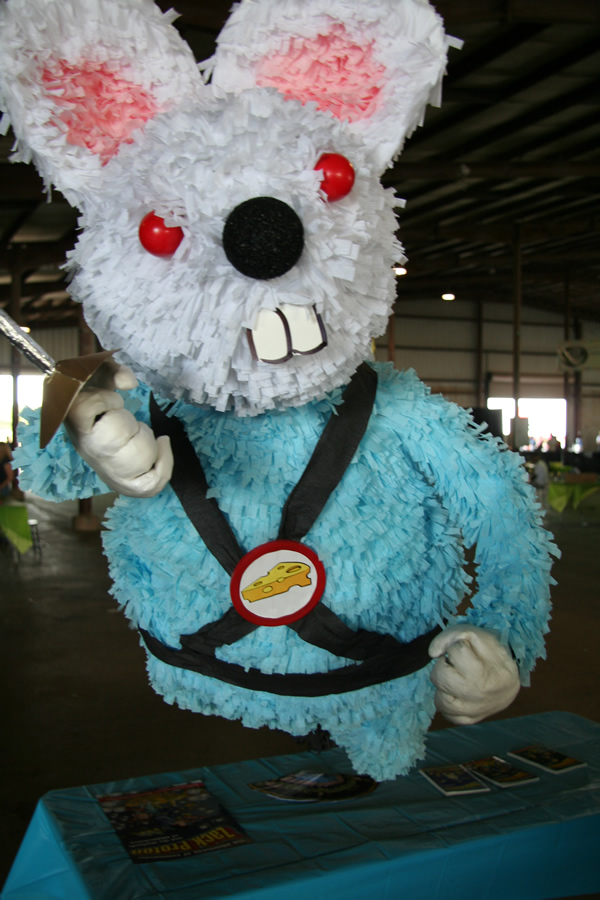
Working with papier mache: It's messy! When I do this in my kitchen, so matter how careful I am there are always drops of papier-mache paste all over the place. I usually do this part in my back yard. Use about a 1:1 ratio of water and flour. I don't measure, I just put water in a bowl, start scooping in flour, and mix with a whisk until it's like pancake batter. If you use thicker paste, it makes for a harder layer. If you use thinner paste, the layer ends up being weaker. I usually just go safely down the middle. Use different width strips of newspaper for the papier mache. For the initial coverage layers I usually use wide strips, sometimes more than 2" wide. For smaller areas, I use strips as thin as 1/2" wide. If you make the strips too wide, they will tear under their own weight when you dip them into the paste. I use different lengths of newspaper as well -- sometimes I use the entire height of the paper in one long strip, but sometimes I tear it in half and work with shorter strips. Choose the most convenient length and width of strip for what you're doing. Cut the newspaper strips with a paper cutter if you're neurotic like me. My attempts to tear newspaper strips often resulted in "pear-shaped" strips, which went on sloppier than I would have liked. With a paper cutter, I can get perfect straight lines, and also have better control over the widths. It sounds a little eccentric perhaps, but I find working with cut newspaper a lot easier than torn newspaper. Use a wide bowl for the paste. A bowl with outward sloping sides is much easier to work in. A bowl with sides that are nearly vertical is harder to work with. Make the hanging point super thick. I always use a wire shirt hanger as the hanging hook. I attach it through the inside top of the piñata with the loop poking out through the top. I always make the top of the piñata the thickest, since the hanging hook will be attached there, and the kids aren't going to break this part anyway. Hanging hooks can fail in two ways: 1) the piñata isn't strong enough to bear the weight where the hook is attached, and the papier-mache tears, or 2) the hook isn't adequately attached to the piñata, and comes off or (if it is attached through the top of the piñata) slips through the top of the piñata. Just to be certain that the hook will not come out, I always attach my hooks to a piece of cardboard, and then either tape the cardboard onto the newspaper-wrapped ballons and put papier mache over the cardboard to cementing the entire piece of cardboard into the top of the piñata, or I do all the papier mache work first and then duct tape the cardboard to the inside top of the piñata. This is how I make hanging hooks for piñatas: Then I'll use masking tape to hold the hook in place at the top of the piñata and start papier-maching over it. On a larger piñata I sometimes don't know where the hook is going to go until after I have finished all the papier-mache work. In those cases I make the hook as described above, but straighten out the hook at the top so that it is sticking straight up. Then I'll cut the pinata open and stick the hook assembly through the top of the piñata from the inside, and then usually duct tape it in place. Sometiems then I have to go back and patch up the hole I made to get the hook in. Always make sure the hook is a closed loop -- don't just bend the hanger's hook back into its original J shape, or it may straighten itself out during the whacking and allow the piñata to fall. If you look on the Warlord of Nibblecheese page, you can see the inside cardboard of the hanging hook in the picture where the Earth kid annihilates the space mouse. You might also notice that the shirt hanger hook on that piñata is about 15 inches long. I had never made one that long before, but I had to for this piñata because the jet pack on the mouse's back covered both the hook and the filling hole. So the hook had to be long enough to stick through the jet pack, and the jet pack had to be "removable" in order to fill the piñata. My solution was to use a long straight wire before the closed loop on the end; that way I could slide the jet pack up the wire to fill the piñata, then slide it back down again to start. Make sure you hang the piñata from the candy compartment. If you have a body-shaped piñata, for example, don't hang it from the top of the head if the candy (and the weight) is all in the body portion, or it may break at the neck. This is exactly what happened with the Green Dragon piñata. Put the hook at the top of the back instead, so the candy compartment of the piñata is directly supported. Test your hanging spot before making it permanent. If you have an oddly-shaped piñata, you want to find out where the center of mass is so that it doesn't end up hanging too far forward or too far back. Looking at the Warlord of Nibblecheese, for example, moving the hanging hook as little as an inch backward made him hang horizontally, while moving it an inch forward made him hang almost vertically. I wanted an angled hanging, and had to punch a few "test holes" in him to see how he would hang. Also consider the effect of adding candy! That additional weight may shift the center of mass of the piñata. Weaken tough piñatas. With larger piñatas especially, you have to make them a certain minimum thickness just to support their own weight, and then they're too tough for the kids to break. So take a razor knife and scratch the piñata (inside or out, it doesn't matter) to create weak areas, or use a regular knife and stab the piñata repeatedly to weaken the walls. Decorating with crepe paper: Painting a piñata is always an option, and there are many other ways you can decorate as well. I use crepe paper whenever possible because it's festive and colorful and does a great job of hiding the flaws underneath. Decorating with crepe paper will strengthen your piñata. The fluffed area becomes a kind of padded armor, and makes the pinata more difficult to break. Keep this in mind when you're planning how difficult you want it to be to break the piñata. Not all crepe paper is created equal. First, I should say that any crepe paper will work. But some work much better than others. If I could give you only one warning about crepe paper, it would be to never use one of the big rolls. Those are stretched too tightly onto the roll, and lose all their texture. For lots more information about different crepe papers and their use on piñatas, see the crepe paper page. You want crepe paper with a rough, uneven, bumpy surface. Some crepe paper is smoother, with small creases in it rather than bumps. This paper is thinner than the other, and does not hold its shape as well. What this means in terms of piñatas is that when you fluff the piñata at the end, the rough paper stays fluffed better, and the thinner, smoother crepe paper tends to fall back down, making a flatter, less fluffy piñata. One way to tell the better paper is to look at the roll from the side. If it has lots of small, uneven gaps between the layers, it's the good stuff. If it is tightly wound with no gaps, it's flatter, thinner paper. Hobby Lobby is the cheapest at 33 cents a roll, and their paper is pretty good. Party Pig and Party City charge more than twice as much, and their crepe paper is usually not as good. (Party City used to sell a brand called STREAMER by Cindus, but it looks like they're not carrying that where I live any more. But even the STREAMER brand, on the large rolls, was bad for piñata decorating. ) When snipping crepe paper, make each snip go about 2/3 of the way from one edge to the other. If you make them too short, your piñata will have shorter fluffies, and you will also have larger spots of crepe paper glued directly onto the piñata. You can always cover this with another layer of snipped crepe paper, but this adds more work to the job. Snipping too far doesn't give you enough area on the crepe paper to glue onto the piñata, and results in thin strips of newspaper showing through between layers of crepe paper. I have added detailed instructions for cutting crepe paper on the Cutting Crepe Paper page. When snipping crepe paper, do it many layers at once. First, take your scissors and your roll of crepe paper, and slide the bottom tooth of the scissors all the way through the roll, about 10 or 12 layers down, and snip all the way through. This will give you a small stack of crepe paper. Use the scissors to make snips through 10 or 12 layers at once. Draw color guidelines on the undecorated piñata. If you plan to have different sections in different colors, draw the boundary lines on the piñata before you start decorating. Once you start, it becomes a lot harder to judge where the colors should begin or end. How to cover a big area in a hurry: First, cut a whole lot of crepe paper of the color(s) you need, and separate them into individual pieces. Then squirt Elmer's glue in a wide area on the piñata (maybe six inches by twelve inches). I use the glue bottle to run a bunch of circles over the area, leaving thin trails of glue all over. You don't have to completely cover the piñata surface with glue, but you want fairly even coverage. Then take your snipped crepe paper one piece at a time and lay it on the glued area, working from the bottom up so that the snipped fringe never touches the glue. Use regular Elmer's Glue. Don't use Elmer's School Glue. Elmer's school glue works, but it's runnier than regular Elmer's glue. If you apply glue to the piñata and spread it around like I described above, regular Elmer's glue will stay in place better. With Elmer's School Glue you will be forced to spread it thinner to prevent running, and then the glue will dry faster -- maybe before you can cover it all with crepe paper. August 2007 update: Borden has changed the formula of Elmer's School Glue to make it not as runny as it used to be. I haven't tried it yet, and since Elmer's School Glue costs the same as Elmer's regular glue, I'm just going to stick with the regular stuff. Stock up on glue during Back-to-School sales. You can get a 4 oz. bottle of Elmer's glue for 20 cents during August at Wal-Mart or Target. It might be a buck later in the year. Be creative! There are a lot of different ways to decorate piñatas. I use painted ping pong balls for eyes all the time, but sometimes I use styrofoam eggs or large googly eyes instead. (If you can't find big googly eyes at Michael's or Hobby Lobby, try a fabric store like JoAnn's.) I use paper plates and card stock and even pieces of egg cartons, plastic container lids, and disposable cups. Part of the charm of piñata-making is improvising and finding creative ways to achieve the effect you're looking for.
Before you start: Don't sweat the mistakes. You'll make lots of mistakes, but piñatas are very forgiving. Piñatas by their very nature are a kind of comical art form, and minor flaws are part of their charm. Most people won't even notice your mistakes. If you look closely at the Hello Kitty piñata, you'll see that her head isn't an oval, it's actually kind of egg-shaped. And the bat's wings are two different lengths. All of my piñatas have flaws, but the decorating step hides them well and I think the festive nature of the piñata makes the viewer subconsciously more forgiving as well. Working with balloons: Balloons or wires? I tried using a wire frame for a piñata once, and it was a disaster. The wire was sturdy enough to make the piñata, but not sturdy enough to stand up to the whacking. All that bashing disfigured the piñata, making it hang crooked and making it harder to smash open. I don't like the idea of wires to begin with, because if they're too stiff, exposed ends can poke eyes or scratch kids and if they're not stiff enough, you end up with a blobby piñata like I did. So all my piñatas, and all my tips here, are for working from balloons. What about thin cardboard boxes? I never use cardboard for a candy-containing part of a piñata because it's just too hard to break. I will occasionally use cardboard for a non-target part of a piñata, such as the nose of the Rainbow Zebra, but it's very rare that I ever do that. Store-bought piñatas are often invulnerable because they make them from cardboard boxes. If you're going to use cardboard for a target area, make sure you use really thin cardboard, not that brown corrugated stuff, and make sure you weaken the cardboard first by punching lots of holes in it with scissors or a knife. Wrap the balloon in newspaper first. Don't lay papier-mache newspaper strips directly onto the balloon. It can be done that way, but it takes longer, it requires more layers of papier-mache, and you're more likely to have your balloon pop, especially if you let it dry in the sun. Instead, wrap the balloon in newspaper and use masking tape to hold it in place. Try to wrap reasonably smoothly -- you can cut off excess newspaper if you have some. You'll never get a perfectly smooth wrapping, and the first wet layer of papier-mache will help smooth out the bumps, but if you do a really sloppy job of wrapping, it will leave you with a really bumpy piñata. Use different sizes and shapes of balloons. Those long, thin balloons for making balloon animals are really versatile. I used them for making the ghost's arms and the bat's wings, as well as for arms and legs on the Warlord of Nibblecheese, snakes in Medusa's hair, and so on. But blowing those up gives me a bad headache every time, so I bought one of those cheap plastic balloon pumps at Party City. I also use punch balls a lot for larger areas. To wrap a punch ball in newspaper, you first have to tape together two or three sheets of newspaper so you have a much larger sheet to work with, and then wrap the punch ball. Remember that fluffing the crepe paper will add thickness. Fluffing the crepe paper adds about 3/4 of an inch of thickness to whatever you are covering. If you make a person with his arm hanging about an inch away from his side, then when his arm and body are crepe papered and fluffed, his arm will appear attached to his side. On the Make a Zebra page, compare the overall stoutness of the finished zebra to the much slimmer donkey-like statue before it was decorated. Look at the legs and tail in particular to see the effect fluffing has. Tips and Tricks These are random thoughts that are presented roughly in the same order they would be useful in making the piñata. You'll also find more information on the Instructions page, along with step-by-step examples of how I made some of the piñatas on this web site. For information specific to decorating with crepe paper, see the Crepe Paper and Cutting Crepe Paper pages. |
||